
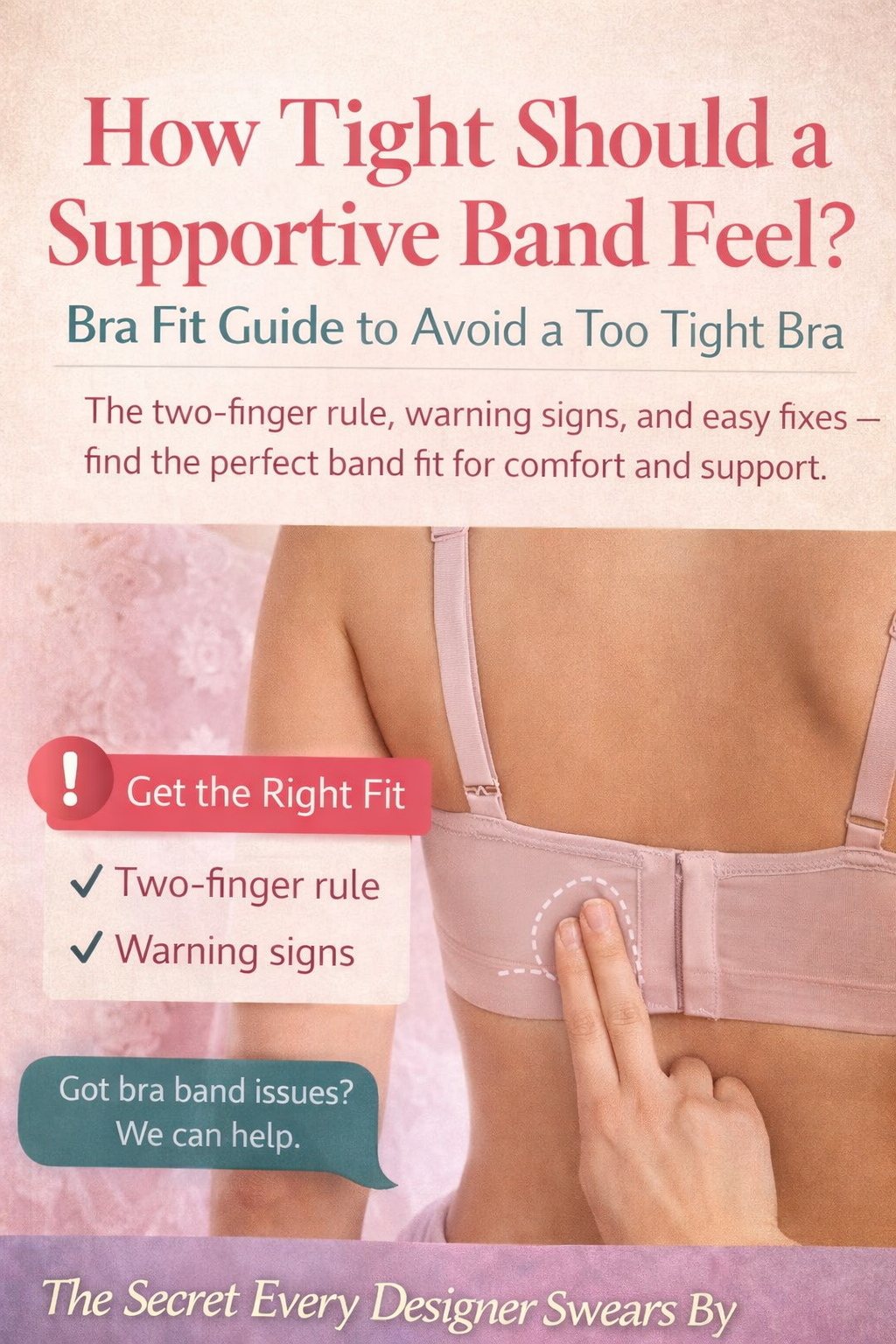
How Tight Should a Supportive Band Feel? Bra Fit Guide to Avoid a Too Tight Bra
The two-finger rule, warning signs, and easy fixes — find the perfect band fit for comfort
and support.
Here is the most common bra mistake women make: buying the right style but wearing the wrong band size.
A bra band that is too tight digs, chafes, and restricts breathing. One that is
too loose fails to provide any real support. Yet most women have never had their band
fit properly checked — or even know what the right fit is supposed to feel like.
This guide answers the question once and for all: how tight should a supportive band
feel? We cover the exact test to use, the signs of a bad fit, how to measure correctly at
home, and what to do if your current bra is too tight.
How Tight Should a Supportive Band Feel? The Industry Standard
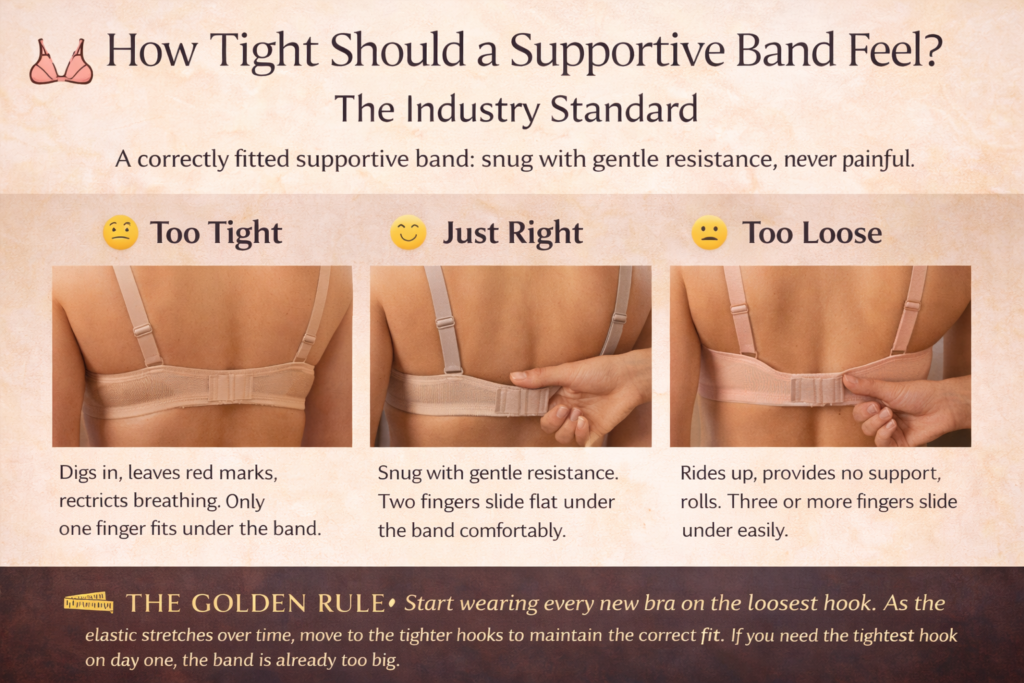
A supportive bra band should feel snug and secure — but never painful,
restrictive, or uncomfortable. Think of it like a firm handshake: you feel the contact
clearly, but it doesn’t hurt.
The band is the most important part of any bra — it provides 80% of the total
support. Your straps provide the remaining 20%. This is why a well-fitted band is
non-negotiable for comfort and posture, particularly for larger cup sizes.
The universal standard used by professional bra fitters at Rigby &
Peller and lingerie specialists worldwide is simple: the band should feel firmly
against your skin all the way around, running parallel to the floor, with no riding up
at the back and no digging at the front.
under the band.
comfortably.
under easily.
hook. As the elastic stretches over time, move to the tighter hooks to maintain the
correct fit. If you need the tightest hook on day one, the band is already too big.
The Two-Finger Band Test: How to Check Your Fit Right Now
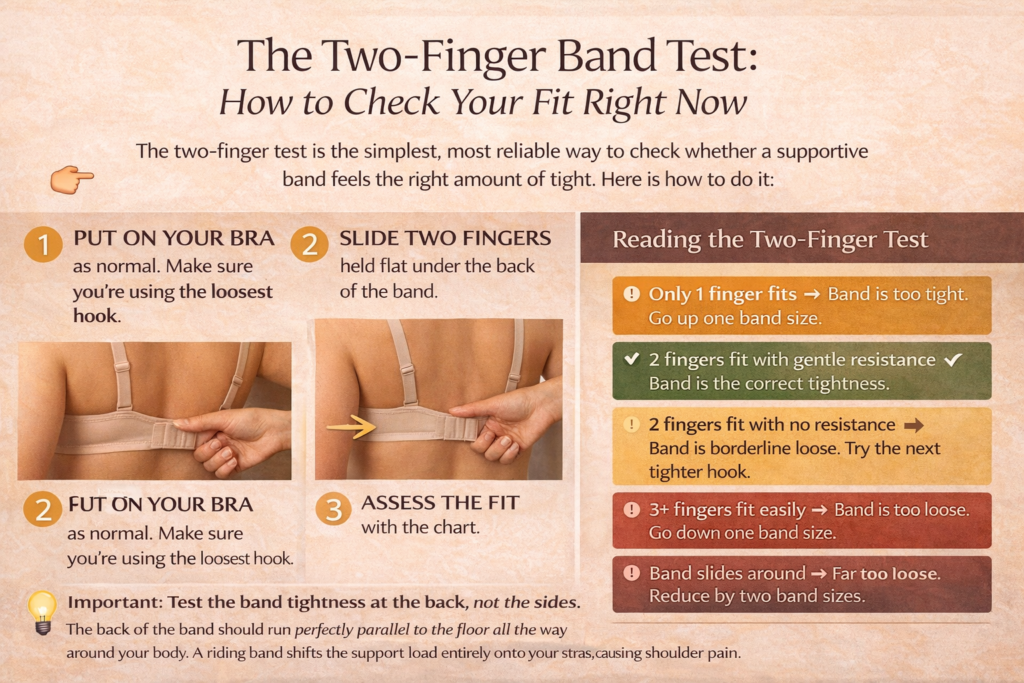
The two-finger test is the simplest, most reliable way to check whether a supportive
band feels the right amount of tight. Here is how to do it properly:
Step 1: Put on your bra as normal. Make sure you’re using the loosest hook (the one
furthest from the clasp).
Step 2: Slide your index and middle fingers, held flat together, underneath the back
of the band.
Step 3: Assess what you feel:
Reading the Two-Finger Test
- Only 1 finger fits → Band is too tight. Go up one band size.
- 2 fingers fit with gentle resistance → Band is the correct tightness. ✓
- 2 fingers fit with no resistance → Band is borderline loose. Try the next
tighter hook. - 3+ fingers fit easily → Band is too loose. Go down one band size.
- Band slides around → Far too loose. Reduce by two band sizes.
The back is where the clasp sits and where the band tension is most consistent. Side tension can
vary based on your body shape and is not a reliable indicator.
Also check that your band runs perfectly parallel to the floor all the way around
your body. If the back rides up higher than the front, the band is too loose — even if the
two-finger test felt okay. A riding band shifts the support load entirely onto your straps.
Signs Your Bra Band Is Too Tight (and What It’s Doing to Your Body)
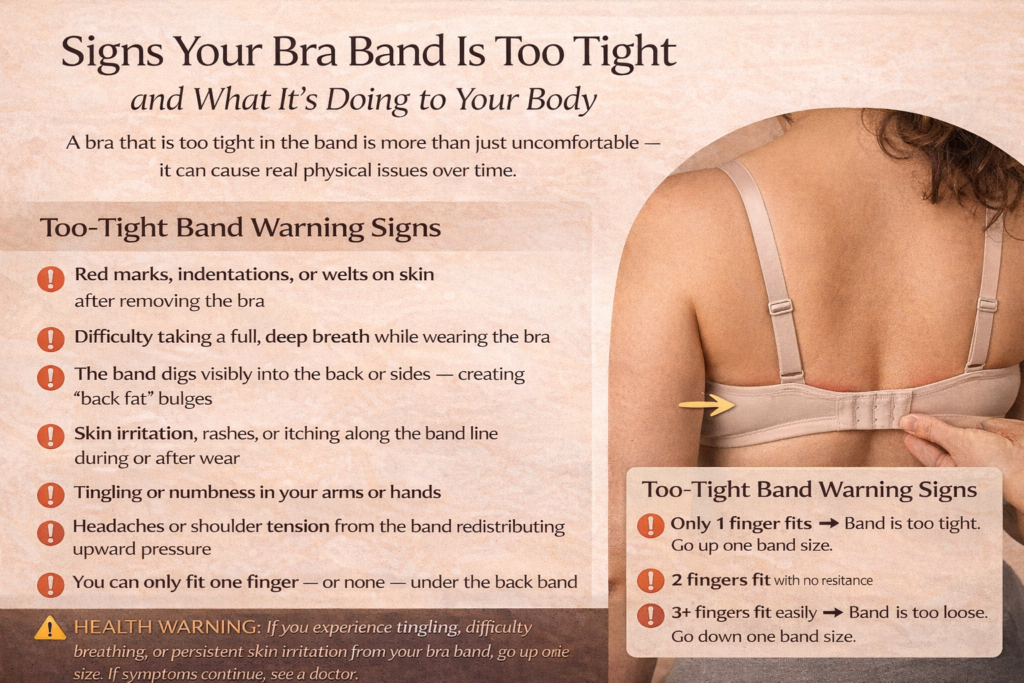
A bra that is too tight in the band is more than just uncomfortable — it can cause
real physical issues over time. According to Cleveland Clinic, chronic pressure from an ill-fitting bra band can cause
nerve compression, restricted circulation, and persistent skin irritation.
These are the clearest signs your supportive band is too tight:
Too-Tight Band Warning Signs
- Red marks, indentations, or welts on skin after removing the bra
- Difficulty taking a full, deep breath while wearing the bra
- The band digs visibly into the back or sides — creating “back fat” bulges
- Skin irritation, rashes, or itching along the band line during or after wear
- Tingling or numbness in your arms or hands (nerve compression)
- Headaches or shoulder tension from the band redistributing upward pressure
- You can only fit one finger — or none — under the back band
breathing, or persistent skin rashes from your bra band, see a doctor. These can be symptoms of
nerve compression or restricted lymphatic drainage — both serious if left unaddressed.
The most immediate fix: go up one band size and down one cup size to maintain the
same cup volume (see Section 06 on sister sizing). Most women wearing a too-tight band find that
their cup suddenly fits better too — because the band was pulling the cup out of position.
Signs Your Bra Band Is Too Loose (and Why It Matters More Than You Think)
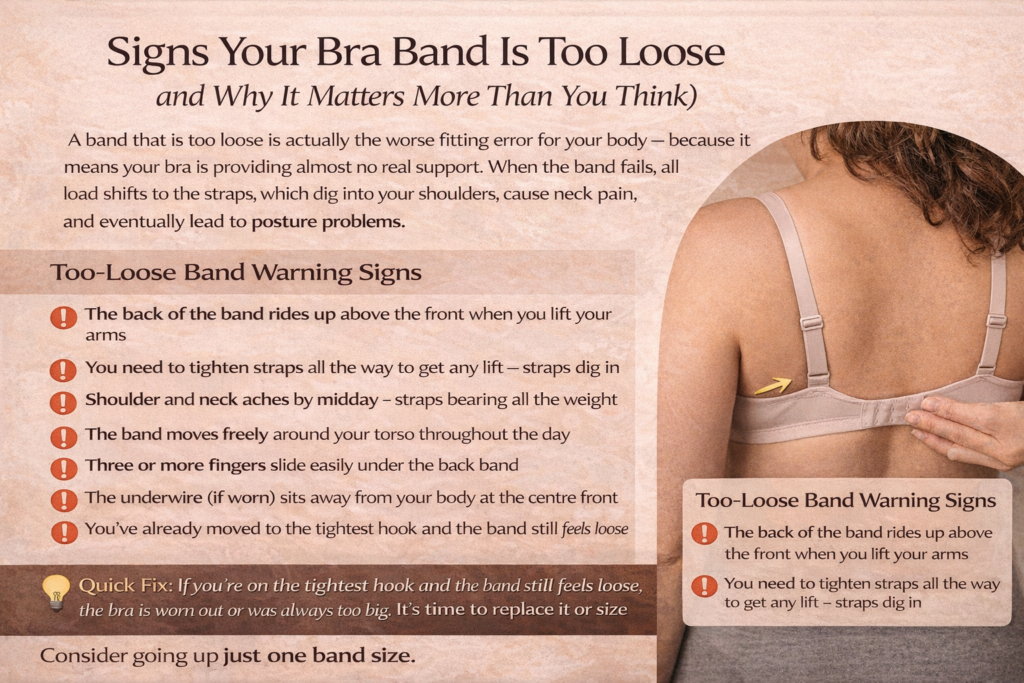
A band that is too loose is actually the worse fitting error for your body — because it
means your bra is providing almost no real support. When the band fails, all load shifts to
the straps, which dig into your shoulders, cause neck pain, and eventually lead to
posture problems.
Signs your bra band is too loose:
Too-Loose Band Warning Signs
- The back of the band rides up above the front when you lift your arms
- You need to tighten straps all the way to get any lift — straps dig in
- Shoulder and neck aches by midday — straps bearing all the weight
- The band moves freely around your torso throughout the day
- Three or more fingers slide easily under the back band
- The underwire (if worn) sits away from your body at the centre front
- You’ve already moved to the tightest hook and the band still feels loose
bra is worn out or was always too big. It’s time to replace it or size down. A good bra band should
last 6–12 months of regular wear before losing its elasticity.
How to Measure Your Bra Band Size at Home (Accurately)
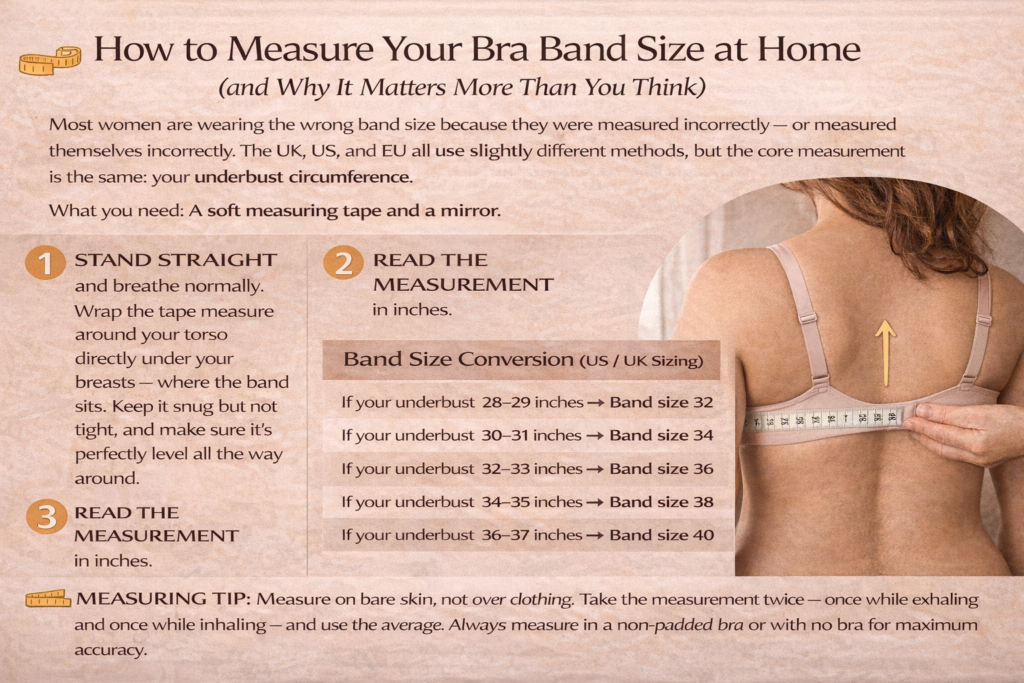
Most women are wearing the wrong band size because they were measured incorrectly — or measured
themselves incorrectly. The UK, US, and EU all use slightly different methods, but the core
measurement is the same: your underbust circumference.
What you need: A soft measuring tape and a mirror.
Step 1: Stand straight and breathe normally. Wrap the tape measure around your torso
directly under your breasts — where the band sits. Keep it snug but not tight, and
make sure it’s perfectly level all the way around.
Step 2: Read the measurement in inches.
Step 3: Apply your region’s sizing convention:
Band Size Conversion (US / UK Sizing)
- If your underbust is 28–29 inches → Band size 32
- If your underbust is 30–31 inches → Band size 34
- If your underbust is 32–33 inches → Band size 36
- If your underbust is 34–35 inches → Band size 38
- If your underbust is 36–37 inches → Band size 40
the measurement twice — once while exhaling and once while inhaling — and use the average. Always
measure in a non-padded bra or with no bra for maximum accuracy.
Sister Sizing: The Smart Fix When Your Band Feels Wrong
Sister sizing is one of the most useful bra fitting concepts most women don’t know about. It means
you can change your band size without changing your cup volume — by adjusting both
measurements simultaneously.
The rule: When you go up one band size, go down one cup letter. When you go down one
band size, go up one cup letter. The total cup volume stays the same — only the band tension
changes.
Sister Size Chart — Common Examples
- 32D ↔ 34C ↔ 36B (same cup volume, different band tension)
- 34DD ↔ 36D ↔ 38C (same cup volume, different band tension)
- 30E ↔ 32D ↔ 34C (same cup volume, different band tension)
- 36F ↔ 38E ↔ 40DD (same cup volume, different band tension)
- 28G ↔ 30F ↔ 32E (same cup volume, different band tension)
fits perfectly → go up one band, down one cup. If the band is too loose but the cup fits → go down
one band, up one cup. This is the fastest fix without needing a full re-measurement.
Sister sizing works best as a fine-tuning tool within one size difference. If you need to change band
size by more than one step, a full re-measurement and re-fitting is recommended.
When to Replace Your Bra Band (and How to Make It Last)
Even a perfectly fitted bra will eventually develop a band that feels too loose — not because you
measured wrong, but because elastic fibres wear out. The average bra band lasts 6–12
months of regular wear before losing significant elasticity.
Signs the elastic is gone and it’s time to replace your bra:
When to Replace Your Bra
- You’re on the tightest hook and the band still feels loose or rides up
- The band fabric looks stretched, puckered, or distorted in shape
- The underwire has started to poke through the fabric casing
- The band has lost its shape after washing — no longer lying flat
- You’ve owned it more than 12 months of regular (every 2–3 days) wear
each one every third day. This gives the elastic time to recover between wears. Always hand wash in
cool water or use a delicates bag. Never tumble dry — heat destroys elastic fibres permanently.
The Perfect Bra Band Fit — Your Checklist
Two fingers slide flat under back band with gentle
resistance
Band runs parallel to floor — level all the way around
Using the loosest hook on a new bra
Band stays in place when you lift your arms overhead
No red marks or indentations on skin after 8 hours
Breathing is comfortable — no restriction on deep inhale
No shoulder or neck ache by end of day
Straps adjusted loosely — not bearing the main support
load
Common Bra Band Fit Mistakes to Avoid
These are the errors that keep women in uncomfortable, unsupportive bras for
years:
-
Buying the same band size you’ve worn for years without re-measuring. Weight,
hormones, age, and pregnancy all change your underbust measurement. Re-measure every 12 months
or after any significant body change. -
Starting on the tightest hook. If you need the tightest hook on a brand-new
bra to get a snug fit, the band is too large. New bras should always start on the loosest hook
with room to tighten as they age. -
Compensating for a loose band by overtightening straps. Straps cannot replace
band support. Overtightened straps dig into shoulders, cause neck pain, and create permanent
grooves. If your straps need to do all the work, your band is the wrong size. -
Ignoring red marks because “all bras do this.” They don’t. Red marks are a
clear signal that the band is too tight or the bra doesn’t fit your body shape correctly. A
well-fitted band leaves no marks after 8 hours of wear. -
Wearing a bra until the elastic is visibly gone. A stretched-out band provides
no support at all — it’s just fabric resting against your skin. Replace bras every 6–12 months
or as soon as they fail the two-finger test on the tightest hook.
Frequently Asked Questions: How Tight Should a Supportive Band Feel?
How tight should a supportive band feel?
A supportive bra band should feel snug with gentle resistance — never
painful. The standard is the two-finger test: two fingers should slide flat under the back of the
band with slight resistance. If only one fits, it’s too tight. If three or more fit easily, it’s too
loose.
What are the signs your bra band is too tight?
Signs your bra band is too tight include: red marks or indentations on skin after
removing it, the band digging into your back or sides, difficulty breathing deeply, back tissue
pushed out above or below the band, and only being able to fit one finger (or none) under the band.
Is it better for a bra band to be too tight or too loose?
Neither is ideal, but a too-loose band is worse for your body. The band provides 80% of
all breast support. A loose band shifts that entire load to your straps and shoulders, causing neck
and back pain. Correct fit is always the goal — the two-finger test is your guide.
Why does my bra band feel tight but my cup fits fine?
This usually means you need to sister size: go up one band size and
down one cup letter (e.g. 34C → 36B). The cup volume stays the same, but the band tension is
reduced. This is the most common fix for a band that feels too tight with a well-fitting cup.
Can a bra band that is too tight cause health problems?
Yes. A chronically too-tight bra band can cause skin irritation, restricted breathing,
pressure on the ribcage, nerve compression (tingling in arms or hands), and posture problems over
time. If you experience these symptoms, re-measure and resize immediately, and consult a doctor if
symptoms persist.
How do I know if my bra band is the right size?
A correctly fitted band passes three checks: (1) two fingers slide flat under the back
band with gentle resistance; (2) the band runs parallel to the floor all the way around — it doesn’t
ride up; (3) after a full day’s wear on the loosest hook, it hasn’t shifted and leaves no red marks
on your skin.
Find the Perfect Supportive Band Fit
The answer to how tight a supportive band should feel is straightforward once you know
the rule: snug with gentle resistance, two fingers flat, running level around your body, no marks, no
pain. Everything else — cup fit, strap comfort, and all-day support — follows from getting the band
right first.
Use the two-finger test today. If you fail it, try the next band size up or use sister sizing. Then
recheck in 3 months as the elastic settles. A correctly fitted band is the single most impactful bra
upgrade you can make.
For more guidance, explore our guides on
Best Breathable Bras for Summer Heat
and
How to Stop Underboob Sweat
for practical daily comfort tips.
Save this guide and share it with someone who’s been battling an uncomfortable bra — the fix is simpler
than they think.
Wondering how tight a supportive band should feel? Our bra fit guide explains the two-finger band test, signs your bra is too tight, and how to find the perfect fit for all-day comfort and support.