
Best Bras for Teens: Comfortable, Breathable & Supportive Styles for Growing Girls
From the very first bra to the most breathable pick for summer — every style a teen (or her
mom) needs to know about.
Finding the right bra during the teenage years is genuinely one of the trickier shopping moments for
moms and daughters alike. Growing bodies change fast — sometimes every few months — and the wrong bra
can mean discomfort, poor posture, and a teen who simply refuses to wear one at all.
This guide cuts through the overwhelm. Whether you’re searching for a gentle first bra,
the most breathable bra for summer, a supportive sports bra for active
teens,
or a seamless style that disappears under a school uniform — we’ve covered every stage and every need.
Let’s find the right fit.
When Should a Teen Start Wearing a Bra?
There is no single “right age” to start wearing a bra. According to KidsHealth by
Nemours, breast development typically begins between ages 8 and 13, and the need for a bra
usually follows 6–12 months into breast budding — when there is visible breast development under the
skin.
The more practical signals to watch for are:
Signs It May Be Time for a First Bra
- Breast buds have appeared and are visible through thin clothing
- Your daughter mentions feeling self-conscious at school or during PE
- She notices movement or bouncing that feels uncomfortable
- She asks about wearing a bra herself — that’s the clearest green light
- Nipples are visible through her clothing and causing embarrassment
uncomfortable, starting with a soft training bra or bralette is always a gentle,
low-pressure first step. The goal is comfort and confidence — not a “perfect” fitting bra right
away.
A great first bra doesn’t need to have structure or padding. A simple wireless bralette in a
soft cotton-blend fabric is ideal — it offers light coverage and a sense of security
without any of the complexity of a full bra.
Best Types of Bras for Teens — and When to Wear Each
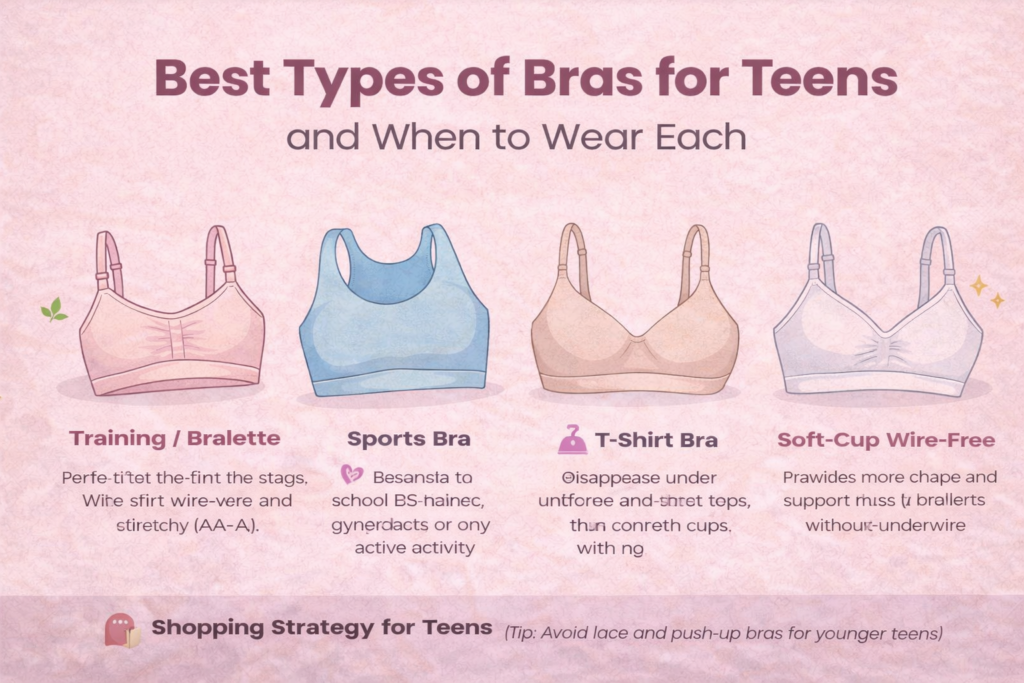
Here are the four categories every teen wardrobe should include:
Offers light coverage with no structure. Best for small cup sizes (AA–A).
Choose medium-impact styles with wide underbands and moisture-wicking fabric.
lace or texture. The everyday essential for school days.
Great for cup sizes A–C who want a little more structure for daily wear.
bras
for school, 1–2 sports bras for PE and activities, and one neutral T-shirt bra for
dressier outfits. That’s a complete teen bra wardrobe.
Avoid lace styles, rigid cups, or padded push-up bras for younger teens. These are better suited to
older teens (16+) who have a more stable size. For growing girls, prioritise stretch,
softness, and adjustability above everything else.
Best Breathable Bra for Summer: Staying Cool & Comfortable
Hot weather makes bra comfort a top priority. Nothing is more miserable than a foam-padded bra
trapping
heat all day during summer school or vacation. A breathable bra for summer has
these
four qualities:
What Makes a Teen Bra Breathable
- Fabric: 100% cotton, bamboo, modal, or moisture-wicking microfiber — never
thick foam - Construction: Unlined or lightly lined cups that allow airflow through the
fabric - Colour: Light and neutral shades absorb less heat than dark colours
- Style: Wide underbands and mesh panels prevent the underband from becoming
a sweat trap
For summer, the top picks are:
machine washable, and feels soft all day even in humidity. Cheap, widely available.
Look for racerback styles with mesh panels across the shoulder blades.
perfect for long summer days. Softer than cotton and extremely low-maintenance.
near-constant airflow. Best worn under looser tops or tees where the texture won’t show.
sponge. Opt for unlined or lightly lined styles. If teen needs shape, a lightly
lined cotton bralette offers the best of both worlds: breathable fabric + gentle coverage.
How to Find the Right Teen Bra Size at Home
Getting the correct size is the single most important step. A bra that is too tight causes discomfort
and skin irritation. One that is too loose provides no support at all. The good news: measuring bra
size at home takes under 5 minutes.
📏 Home Measuring Guide
Round to the nearest even number. That’s your band size (e.g. 30, 32, 34).
the nipple line), keeping the tape parallel to the floor.
4″ = D cup. Example: 34″ bust − 32″ band = 2″ = 32B.
single growth spurt. Check sizing seasonally, especially ages 12–16.
By mid-teens many move into 32B, 34A, or 34B. If she measures a 29″ band, round
down to 28 or try a 30 — always try both to find the best fit.
Remember: bra sizing varies between brands. A 32B in one brand may fit differently in another. Use
measurements as your starting point, then try bras on and use the
two-finger band test — you should be able to slide two fingers under the back band
with gentle resistance. If you can pull it 4+ inches away from the back, it’s too loose.
What Fabrics Are Best for Teen Bras?
Fabric is everything when it comes to comfort, especially for teens who are still figuring out what
feels good. Developing breast tissue can be tender and sensitive — harsh synthetics, scratchy lace,
or rough seams can make wearing a bra an unpleasant experience.
| Fabric | Best For | Avoid If… |
|---|---|---|
| 100% Cotton | Everyday wear, sensitive skin, summer. Breathable and hypoallergenic. | High-impact sports — cotton absorbs sweat and stays wet. |
| Modal | Buttery-soft all-day comfort. Drapes beautifully and doesn’t shrink. Great for bralettes. |
Not ideal for heavy exercise — less moisture-wicking than performance fabrics. |
| Bamboo | Super soft, naturally antibacterial, temperature-regulating. Excellent for summer. | Usually more expensive than cotton. Requires gentle washing. |
| Nylon/Microfiber | Seamless looks under clothing. Lightweight and smooth for school uniforms. | Can trap heat in summer if thick. Choose thin microfiber for warm weather. |
| Polyester/Spandex Blend | Sports bras — excellent moisture-wicking, durable, keeps shape during movement. | Sensitive skin — can irritate with heavy daily use. Not the best for all-day school wear. |
cotton) or “breathable microfiber” for the best of both worlds — softness plus
shape retention. Avoid bras with a rough lace lining against the skin, especially for first bras.
Sports Bras for Active Teen Girls: Support Without Restriction
For teens involved in sports, dance, gymnastics, cheerleading, or even just an active school PE
class,
a proper sports bra is non-negotiable. A regular bra — even a good one — is not
designed to handle the repeated movement that sports demand. Without adequate support, breast tissue
can stretch the supporting ligaments over time.
There are two levels of sports bra support to choose from:
Choosing the Right Sports Bra Impact Level
- Low-impact (yoga, walking, stretching): A supportive bralette or light crop
top with a wide, fitted underband works well. No encapsulation needed. - Medium-impact (PE, dance, cycling, gym class): A compression sports bra
with wider straps and a firm underband. Most teen sports fall here. - High-impact (running, competitive sports, HIIT): A structured sports bra
with encapsulated cups and a firm band — especially important for cup sizes B and above.
elastic),
moisture-wicking fabric, and a snug but not crushing fit. The bra should stay in place with no
bouncing when your teen jumps on the spot. If it moves, it’s not supportive enough.
For teens who are early in breast development (AA–A cup), a compression style sports bra is perfectly
adequate. For teens with a B cup or larger, look for styles with individual cup pockets
(encapsulation
design) for more targeted support and comfort during high-intensity activity.
Mom’s Complete Teen Bra Shopping Checklist
Shopping for bras with a teen daughter can be a surprisingly sensitive moment. Done right, it becomes
a
positive, empowering experience. Here is a checklist to make it as smooth as possible:
Before You Shop
- Measure band size and bust at home — arrive knowing the starting size range
- Ask your daughter what bothers her about her current bra (or bralette), if she has one
- Discuss fabrics and styles she feels comfortable in — let her lead the aesthetic choices
- Plan to buy 3–5 bras so you’re not shopping again in 2 months
What to Check When Trying On
- Band sits flat and parallel all the way around — not riding up at the back
- Two fingers slide under the back band with gentle resistance (not easily, not painfully)
- Cups contain all the breast tissue with no overflow or gaping
- Centre gore (the part between the cups) lies flat against the sternum
- Straps sit comfortably — not digging into shoulders or falling off
- She can raise her arms, reach forward, and breathe deeply without discomfort
size chart and return policy before ordering. Order 2–3 sizes around her
measurement to try. Many affordable, quality teen bras are available from brands like Hanes, Calvin
Klein, Aerie, and Fruit of the Loom — all with easy returns if the fit isn’t right.
5 Common Teen Bra Mistakes (and How to Fix Them)
-
Buying too big “to grow into it.” A bra that doesn’t fit now won’t support
properly now. Buy the correct size for today, and plan to re-measure in 6 months. -
Never adjusting the straps. Straps should be re-adjusted every time a bra
is put on. Straps that are too tight shift the support load to the shoulders instead of the
band. -
Wearing the same bra every day. Rotating between 3–5 bras extends their life
and
allows the elastic to recover between wears. Daily use of one bra stretches it out in weeks. -
Machine-washing on a hot cycle. Heat destroys the elastic in bra bands. Always
wash bras in a lingerie mesh bag on a cool, delicate cycle, or hand-wash. -
Skipping a sports bra for PE. Any breast movement during sport — even for small
cup sizes — stresses the Cooper’s Ligaments. These don’t regenerate. A proper sports bra
during activity is always worth it.
Frequently Asked Questions
or modal fabric. Look for wide, comfortable straps, no underwire, and a seamless construction. Start
with a stretchy XS or size 28A/30A. Brands like Hanes, Fruit of the Loom, and Calvin Klein Halo all
offer affordable, gentle first bras.
They move with the body, don’t dig or poke, and are gentle on developing breast tissue. Cotton and
modal are the most comfortable fabrics — choose these for school wear.
microfiber. Avoid thick padded foam cups in summer — they trap heat. The best summer bras for teens
are unlined or lightly lined cotton bralettes, or mesh sports bralettes. Light colours also help
stay cooler.
rounded to nearest even number. Cup size = bust measurement minus band measurement (1″=A, 2″=B,
3″=C). Re-measure every 6 months during growth spurts — teen sizes change fast, especially ages
12–16.
Underwire can press on growing glandular tissue if the fit isn’t perfect. When teens do try
underwire (usually at cup size C+), the wire must sit flat on the ribcage — never on breast tissue.
Prioritise fit over structure.
when the band rides up, the cups overflow or gape, or straps won’t stay up even on the tightest
setting. Sign it’s time: she avoids wearing it because it’s uncomfortable — always take that
seriously.
The Bottom Line on the Best Bras for Teens
Finding the best bras for teens comes down to three priorities: comfort (wire-free,
soft fabrics, no poking or digging), breathability (cotton or bamboo for everyday wear,
moisture-wicking for sports), and the right size (measured fresh every 6 months during
growth years).
Start simple: a soft bralette, a seamless school bra, and a sports bra for PE. Build from there.
Let your teen guide the choices — the goal is for her to feel comfortable, supported, and confident
in her own skin. That’s what the best bra for any teen should do.
wins over structure, style, and padding — especially in the first few years of wearing a bra.