
How Tight Should a Supportive Band Feel? Bra Fit Guide to Avoid a Too-Tight Bra
The two-finger rule, warning signs, sister sizing, and easy fixes — find the perfect band fit for comfort and support.
Here is the most common bra mistake women make: buying the right style but wearing the wrong band size. A bra band that is too tight digs, chafes, and restricts breathing. One that is too loose fails to provide any real support. Yet most women have never had their band fit properly checked — or even know what the right fit is supposed to feel like.
This guide answers the question once and for all: how tight should a supportive band feel? We cover the exact test to use, the signs of a bad fit, how to measure correctly at home, sister sizing, and what to do if your current bra is too tight.
How Tight Should a Supportive Band Feel? The Industry Standard
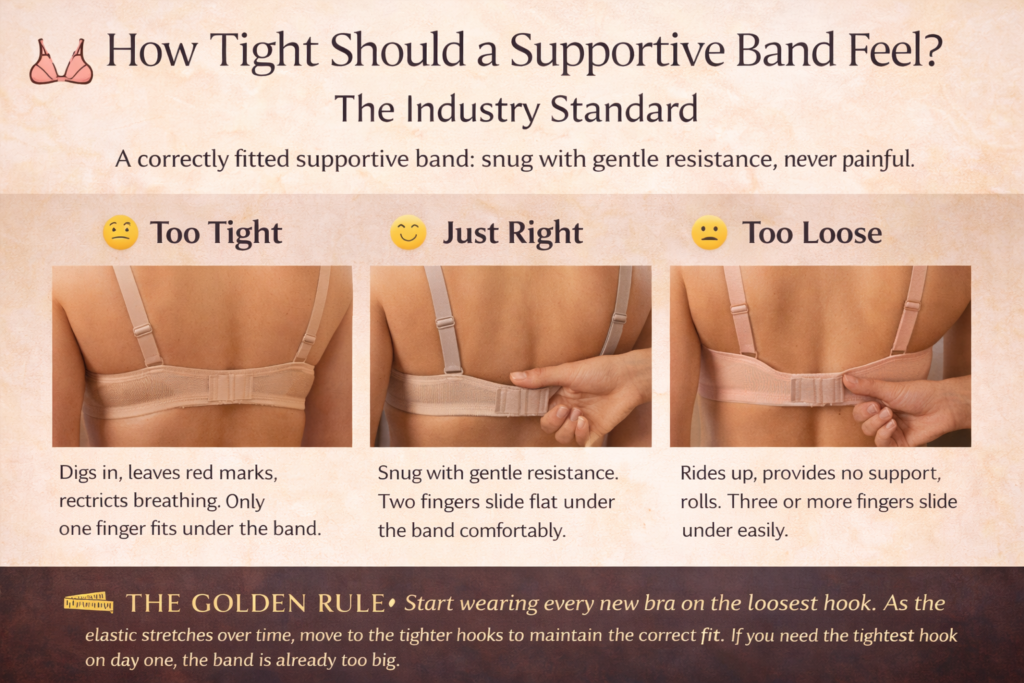 A supportive bra band should feel snug and secure — but never painful, restrictive, or uncomfortable. Think of it like a firm handshake: you feel the contact clearly, but it doesn’t hurt.
The band is the most important part of any bra — it provides 80% of the total support. Your straps provide the remaining 20%. This is why a well-fitted band is non-negotiable for comfort and posture, particularly for larger cup sizes.
The universal standard used by professional bra fitters at Rigby & Peller and lingerie specialists worldwide is simple: the band should feel firmly against your skin all the way around, running parallel to the floor, with no riding up at the back and no digging at the front.
The Two-Finger Band Test: How to Check Your Fit Right Now
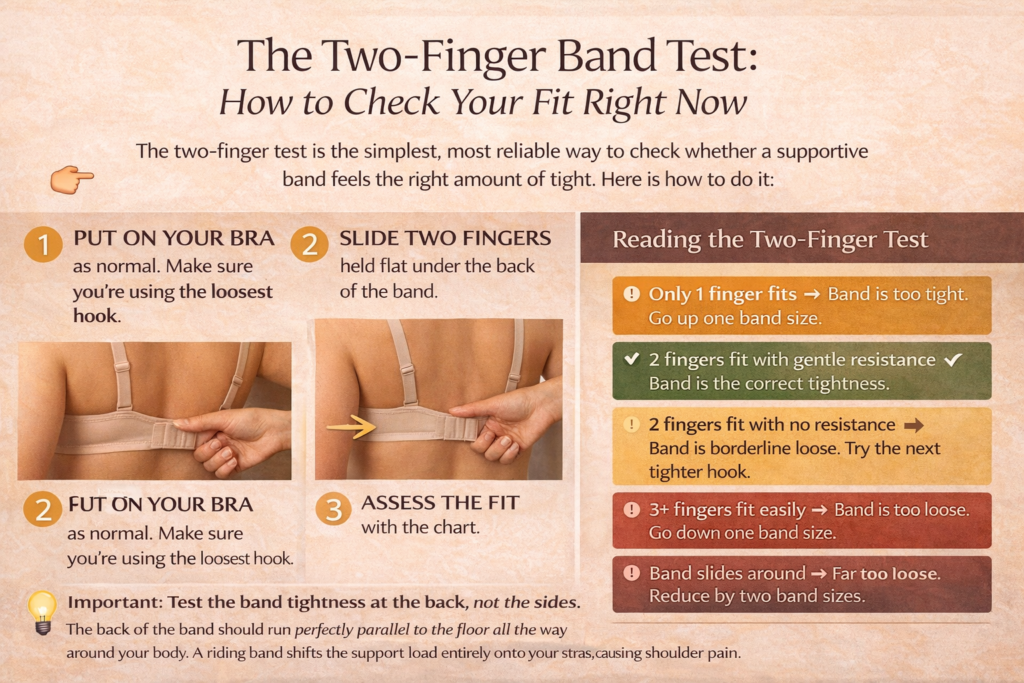 The two-finger test is the simplest, most reliable way to check whether your supportive band feels the right amount of tight. Here is exactly how to do it:
Step 1: Put on your bra as normal. Make sure you’re using the loosest hook (the one furthest from the clasp).
Step 2: Slide your index and middle fingers, held flat together, underneath the back of the band.
Step 3: Assess what you feel:
Reading the Two-Finger Test
- Only 1 finger fits → Band is too tight. Go up one band size.
- 2 fingers fit with gentle resistance → Band is the correct tightness. ✓
- 2 fingers fit with no resistance → Band is borderline loose. Try the next tighter hook.
- 3+ fingers fit easily → Band is too loose. Go down one band size.
- Band slides around freely → Far too loose. Reduce by two band sizes.
Also check that your band runs perfectly parallel to the floor all the way around your body. If the back rides up higher than the front, the band is too loose — even if the two-finger test felt okay. A riding band shifts the support load entirely onto your straps. For a deeper dive into all the warning signs, read our guide on the 5 signs your bra is too tight.
Signs Your Bra Band Is Too Tight (and What It’s Doing to Your Body)
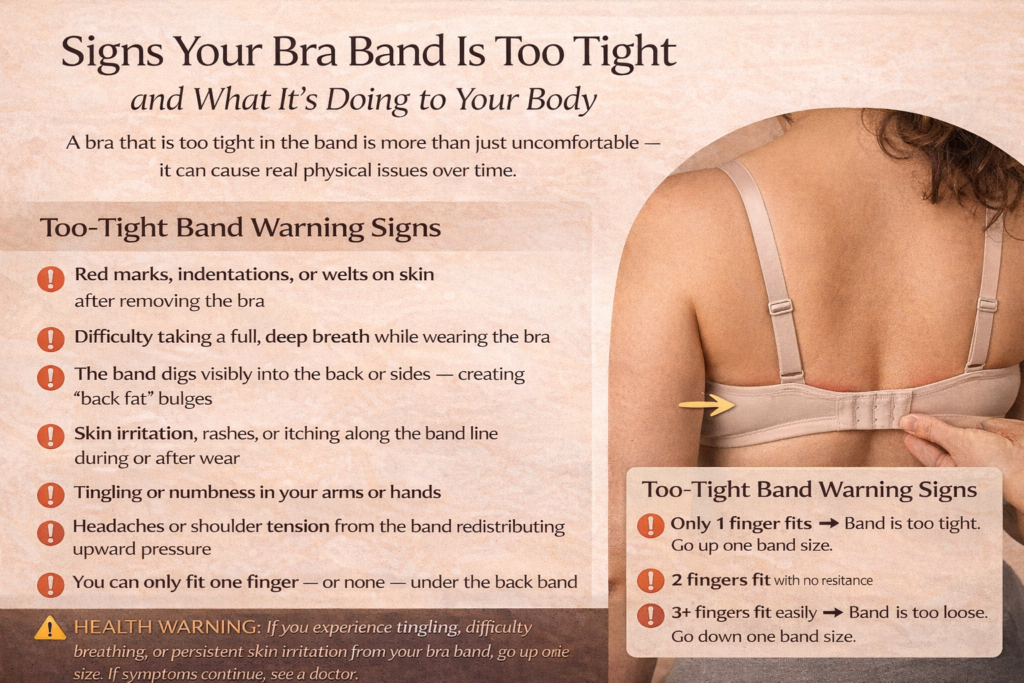 A bra that is too tight in the band is more than just uncomfortable — it can cause real physical issues over time. According to Cleveland Clinic, chronic pressure from an ill-fitting bra band can cause nerve compression, restricted circulation, and persistent skin irritation.
These are the clearest signs your supportive band is too tight:
Too-Tight Band Warning Signs
- Red marks, indentations, or welts on skin after removing the bra
- Difficulty taking a full, deep breath while wearing the bra
- The band digs visibly into the back or sides — creating “back fat” bulges
- Skin irritation, rashes, or itching along the band line during or after wear
- Tingling or numbness in your arms or hands (nerve compression)
- Headaches or shoulder tension from the band redistributing upward pressure
- You can only fit one finger — or none — under the back band
The most immediate fix: go up one band size and down one cup size to maintain the same cup volume (see Section 06 on sister sizing). Most women wearing a too-tight band find that their cup suddenly fits better too — because the band was pulling the cup out of position.
Signs Your Bra Band Is Too Loose (and Why It’s Actually Worse)
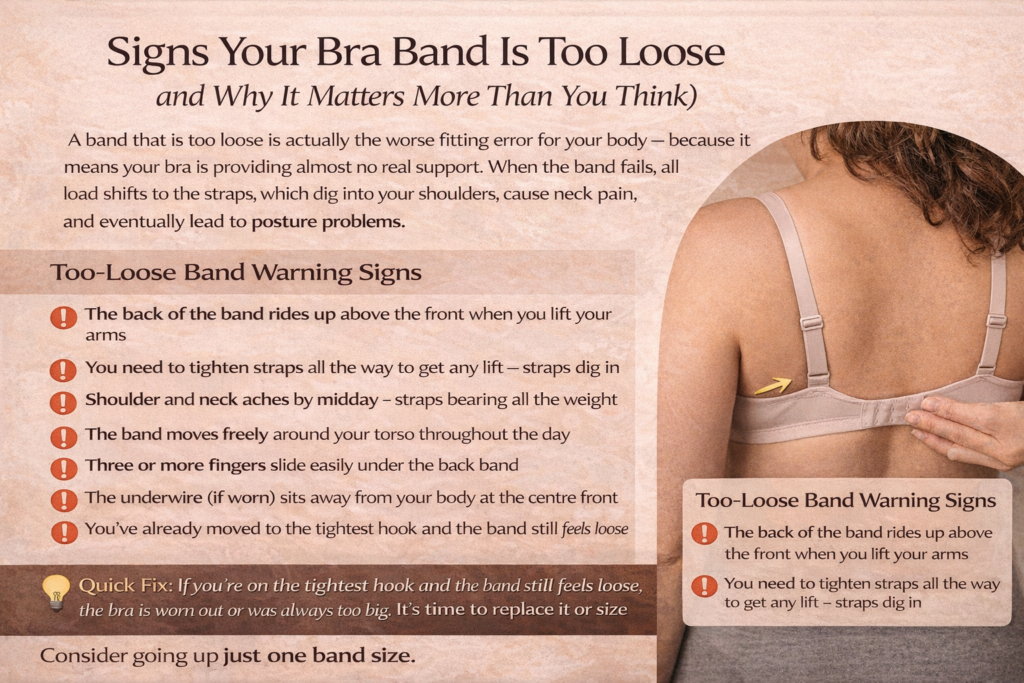 A band that is too loose is actually the worse fitting error for your body — because it means your bra is providing almost no real support. When the band fails, all load shifts to the straps, which dig into your shoulders, cause neck pain, and eventually lead to posture problems.
Signs your bra band is too loose:
Too-Loose Band Warning Signs
- The back of the band rides up above the front when you lift your arms
- You need to tighten straps all the way to get any lift — straps dig in
- Shoulder and neck aches by midday — straps bearing all the weight
- The band moves freely around your torso throughout the day
- Three or more fingers slide easily under the back band
- The underwire (if worn) sits away from your body at the centre front
- You’ve already moved to the tightest hook and the band still feels loose
How to Measure Your Bra Band Size at Home (Accurately)
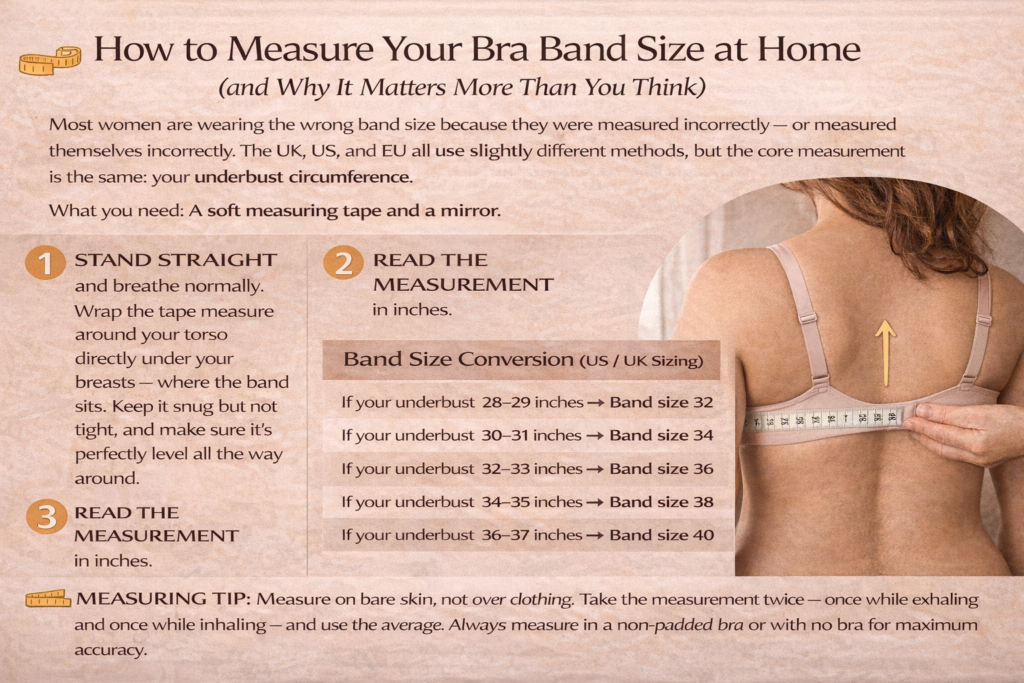 Most women are wearing the wrong band size because they were measured incorrectly — or measured themselves incorrectly. The core measurement is your underbust circumference.
What you need: A soft measuring tape and a mirror.
Step 1: Stand straight and breathe normally. Wrap the tape measure around your torso directly under your breasts — where the band sits. Keep it snug but not tight, and ensure it’s perfectly level all the way around.
Step 2: Read the measurement in inches.
Step 3: Apply your sizing convention:
| Underbust Measurement | Band Size (US/UK) |
|---|---|
| 26–27 inches | 30 |
| 28–29 inches | 32 |
| 30–31 inches | 34 |
| 32–33 inches | 36 |
| 34–35 inches | 38 |
| 36–37 inches | 40 |
| 38–39 inches | 42 |
Sister Sizing: The Smart Fix When Your Band Feels Wrong
Sister sizing is one of the most useful bra fitting concepts most women don’t know about. It means you can change your band size without changing your cup volume — by adjusting both measurements simultaneously.
| ← Tighter Band | Your Current Size | Looser Band → |
|---|---|---|
| 30D | 32C | 34B |
| 32D | 34C | 36B |
| 30E | 32D | 34C |
| 34DD | 36D | 38C |
| 36F | 38E | 40DD |
| 28G | 30F | 32E |
Sister sizing works best as a fine-tuning tool within one size difference. If you need to change band size by more than one step, a full re-measurement and re-fitting is recommended.
When to Replace Your Bra Band (and How to Make It Last)
Even a perfectly fitted bra will eventually develop a band that feels too loose — not because you measured wrong, but because elastic fibres wear out. The average bra band lasts 6–12 months of regular wear before losing significant elasticity.
Signs the elastic is gone and it’s time to replace:
When to Replace Your Bra
- You’re on the tightest hook and the band still feels loose or rides up
- The band fabric looks stretched, puckered, or distorted in shape
- The underwire has started to poke through the fabric casing
- The band has lost its shape after washing — no longer lying flat
- You’ve owned it more than 12 months of regular (every 2–3 days) wear
The Perfect Bra Band Fit — Your Checklist
Common Bra Band Fit Mistakes to Avoid
These are the errors that keep women in uncomfortable, unsupportive bras for years:
-
Buying the same band size you’ve worn for years without re-measuring. Weight, hormones, age, and pregnancy all change your underbust measurement. Re-measure every 12 months or after any significant body change.
-
Starting on the tightest hook. If you need the tightest hook on a brand-new bra to get a snug fit, the band is too large. New bras should always start on the loosest hook with room to tighten as they age.
-
Compensating for a loose band by overtightening straps. Straps cannot replace band support. Overtightened straps dig into shoulders, cause neck pain, and create permanent grooves. If your straps need to do all the work, your band is the wrong size.
-
Ignoring red marks because “all bras do this.” They don’t. Red marks are a clear signal that the band is too tight or the bra doesn’t fit your body shape correctly. A well-fitted band leaves no marks after 8 hours of wear.
-
Wearing a bra until the elastic is visibly gone. A stretched-out band provides no support at all — it’s just fabric resting against your skin. Replace bras every 6–12 months or as soon as they fail the two-finger test on the tightest hook.
Frequently Asked Questions
Find Your Perfect Fit
Browse our collection of properly sized bras — with detailed size guides and free WhatsApp sizing help from our team.