Back Pain and Bra Fit: What You Can Check
Separate bra-fit discomfort from back pain: what the research abstract says, how to check straps and bands, and when to seek medical help.
By US Hosiery EditorialPublished Updated 3 min read
The short answer
Bra-fit checks can help you assess digging straps, a shifting band or uncomfortable cups, but they cannot establish the cause of back pain. Research on fitting should not be read as proof that a bra causes or cures it.
In this guide
A digging strap and an aching back are not the same problem. You can check whether a bra sits comfortably without assuming it explains the pain.
The short answer
A bra that digs or shifts needs a fit check, but that won't tell you what is causing back pain. Changing bras is not a treatment for it. If your back pain isn't improving, speak to a doctor (NHS).
McGhee and Steele’s study compared sizing methods in 104 Australian women and found that self-selected and tape-measured sizes differed from sizes assessed using professional fit criteria. It was a fitting study, not a trial of back-pain treatment (McGhee & Steele, 2010).
The checks below focus on what you can assess: where a strap digs, whether the band slides, and how the cups and wires sit.
Check strap comfort
Breast Cancer Now says straps should fit closely without digging in and provide additional support, rather than carrying the full weight of your breasts (Breast Cancer Now).
Try this:
- Loosen a digging strap a little.
- Check that the cups still contain your breasts.
- Recheck whether the band stays level.
- Stop the comparison if the garment hurts.
If straps feel comfortable only when another part of the bra shifts out of place, compare another size or construction.
Check the band without chasing tightness
The underband should sit firmly and level, without sliding as you move or feeling uncomfortably tight (University of Portsmouth / OpenLearn).
For a new bra, Breast Cancer Now recommends starting on the loosest hooks so it can be tightened as it stretches (Breast Cancer Now).
Look in a mirror, then sit and reach forward. Note whether the band stays in place and whether its edges press uncomfortably. A firmer band is not automatically a better fit.
Check cups and wires too
Your breasts should fill the cups without loose fabric or bulging over the top, bottom or sides. Underwires should lie flat around the breast contour without digging or gaping (Breast Cancer Now).
The University of Portsmouth guide adds that a wire should follow the natural crease beneath the breast rather than rest on breast tissue (OpenLearn).
If a wire or cup edge is the uncomfortable contact point, compare another cup volume or shape. If the wire itself bothers you, try a wireless style.
Make size comparisons deliberately
These examples use UK sizing. A size has a band number and a cup letter, but you need to assess three things separately:
- Band fit: how the bra fits around your body.
- Cup volume: whether there is enough room to contain your breasts.
- Cup shape: whether the cup and wire outline suit you comfortably.
In UK sizing, moving up one band and down one cup step, or down one band and up one cup step, keeps cup volume roughly the same. For example, 34D and 36C are sister sizes (John Lewis).
A sister size changes band fit; it does not add cup volume. For more cup room on the same band, move up a cup step. Going up a band while keeping the same letter increases cup volume too.
Cup letters after D differ between UK, US and European systems; see our international sizing guide. Measurements remain a starting point because sizes vary by brand and style (Breast Cancer Now).
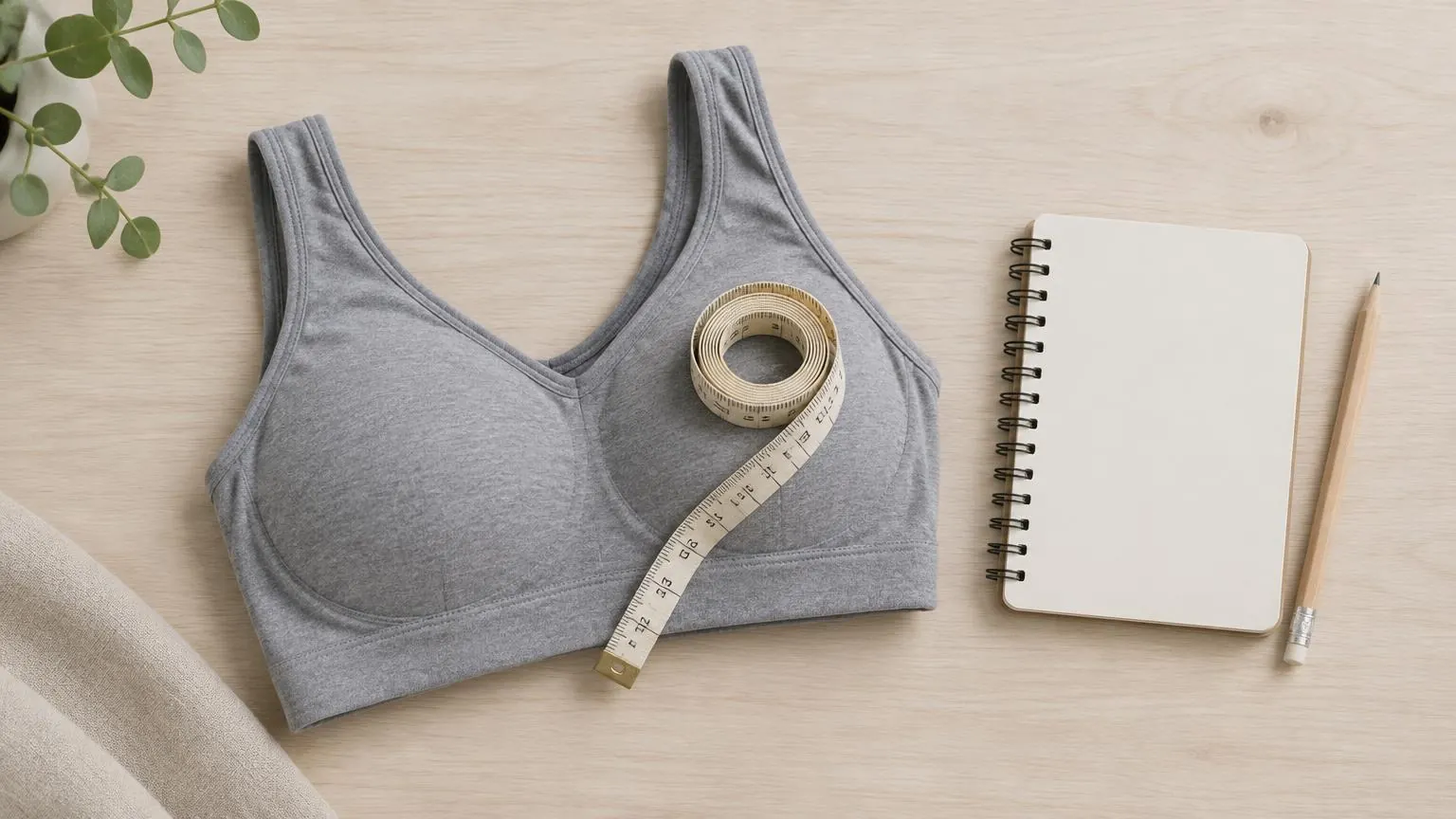
Our measuring guide and bra fit checklist can help you organise a comparison without treating one label as definitive.
When to seek medical help
The NHS says back pain is common and usually improves. Seek medical advice if it is not improving; don’t put off getting help while trying different bras (NHS).
Do not wait to complete fit checks if you have severe or worrying symptoms. Follow the urgent-help guidance on the NHS back pain page or contact your local medical service for advice.
What if taking the bra off feels better?
Note whether it’s pressure at a contact point that eases, or a deeper ache that continues. For garment troubleshooting, note the exact place that felt uncomfortable and whether another bra behaves differently.
If back pain persists, returns or worries you, seek medical advice. You do not need to prove that it is unrelated to your bra before asking for help.
Sources and further reading
External pages referenced in this guide. Brand fitting guides describe that brand's own sizing; check each brand's chart.
- Optimising breast support in female patients through correct bra fit (McGhee & Steele, 2010) (doi.org)
- Your guide to a well-fitting bra (Breast Cancer Now, PDF) (breastcancernow.org)
- Getting the right fit: five-point bra fit guide (University of Portsmouth, via OpenLearn) (open.edu)
- Lingerie size guide: sister sizes (John Lewis) (johnlewis.com)
- Back pain (NHS) (nhs.uk)
Report an outdated detail or broken link
Found something out of date, or a source link that no longer works? Let us know. We read every report and fix errors as described in our corrections policy.
Keep reading