How to Choose a Sports Bra for Your Activity
Choose a sports bra by activity, support construction and fit. Compare straps and fastenings, test it in motion and plan for hot or humid workouts.
By US Hosiery EditorialPublished 5 min read
The short answer
Start with your activity, then compare support construction and fit. A firm, comfortable band and a movement test tell you more than an impact label alone.
In this guide
A sports bra needs to work when you move, not just look right in a mirror. Start with what you'll do in it, then check whether the band, cups and straps stay comfortable through those movements.
The short answer
Choose the brand's suggested support level for your activity, compare compression, encapsulation and combination styles, then try the bra in motion. Look for a level, firm band, contained breasts and straps that don't dig or slip. Sports bras are designed to minimise breast movement, not make you tolerate a painfully tight fit (Breast Cancer Now).
Start with the activity
Brands commonly use low-, medium- and high-impact or support labels. Each brand sets its own, so read its activity guidance as well as the name. In a University of Portsmouth study of 98 sports bras, 69% of those marketed as high support fell into the best-performing third for reducing breast movement, so a label is a starting point rather than a promise (Norris and colleagues, abstract).
Use these examples to narrow your try-on options, not as a fixed classification for every body or brand:
| Your session | Where to start looking | What to check during a try-on |
|---|---|---|
| Gentle yoga, stretching or an easy walk | The brand's low-impact range | Reach, twist and bend; check that the neckline contains you |
| Cycling, brisk walking or controlled gym work | Its medium-impact range | Try your riding or lifting position; check the band and armholes |
| Running, jumping or a class with repeated bouncing | Its high-impact range | Jog and jump; check movement and comfort together |
A sweaty workout isn't necessarily a high-impact one. If you mix activities, test the most demanding movements you expect to do. You can choose more support for a walk if that feels better; you don't need to stay within a label.
Compare how the bra supports you
The University of Portsmouth describes three main constructions (University of Portsmouth):
| Construction | How it works | What to compare on your body |
|---|---|---|
| Compression | Presses breast tissue towards the chest to limit movement | Whether you like the close-held feel and stay contained when bending |
| Encapsulation | Supports each breast separately in its own cup | Whether the cup volume and shape suit each breast |
| Combination | Uses both compression and encapsulation | Whether the cups fit without the outer layer feeling restrictive |
Don't choose solely by cup size or assume that one construction always wins. A study of many sports bras linked encapsulation and adjustable underbands, among other features, with movement reduction; it didn't identify a single feature that explained all support differences (Norris and colleagues, abstract). Compare the complete bra on you.
Check the band before tightening the straps
Use the five-point fit check: band, cups, straps, underwire where present, and centre front. The band should stay level and firm without sliding or feeling uncomfortably tight. Cups should contain the breasts without bulging or gaping; wires should follow the breast crease, not sit on breast tissue (OpenLearn / University of Portsmouth).
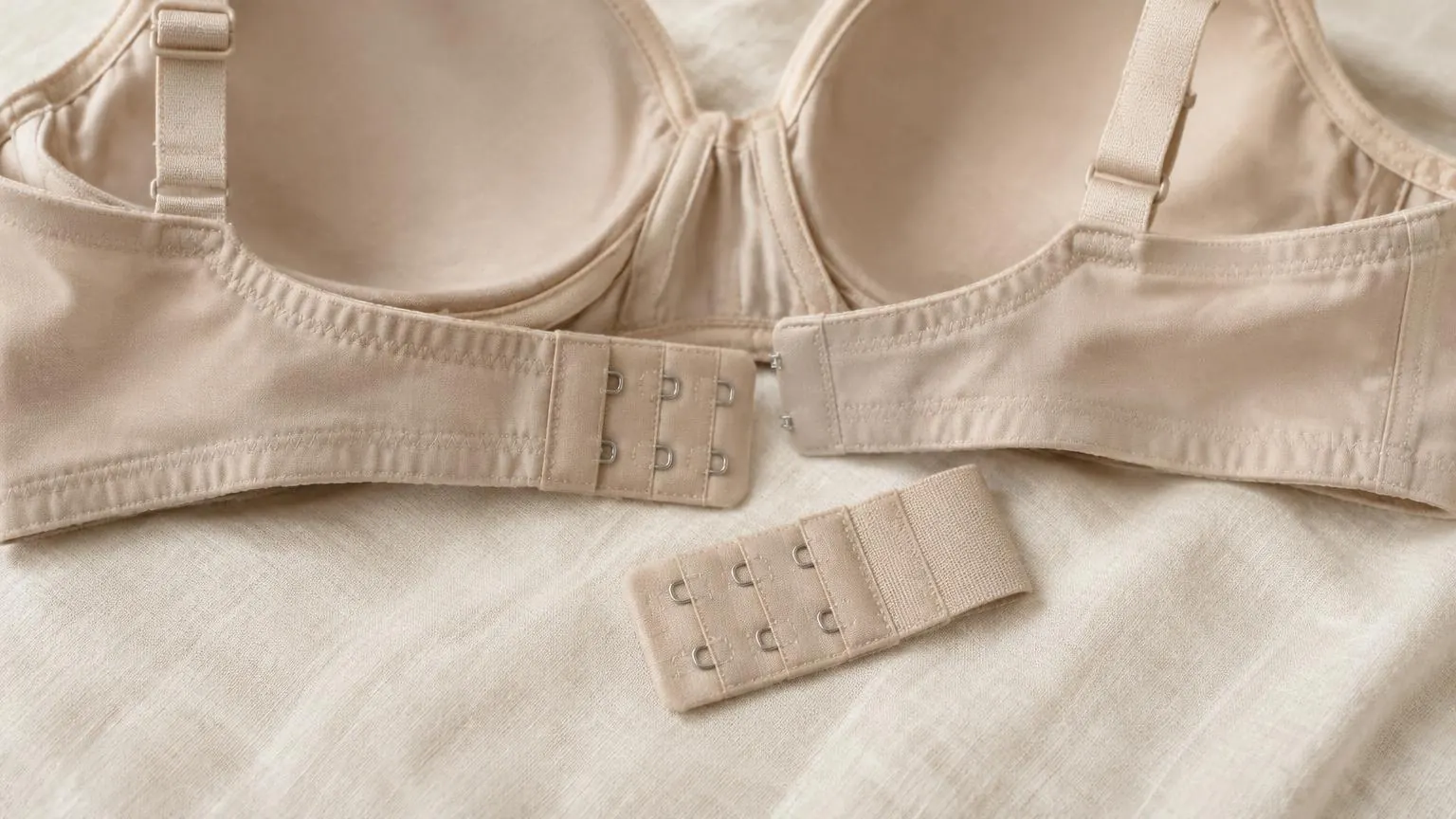
For a hook-fastening bra, start on the loosest hooks so there's room to tighten as it stretches. Straps should add support without carrying the whole weight, digging in or slipping (Breast Cancer Now). If you're shortening them hard to stop movement, recheck the band and cups first. Our band guide goes through that check in more detail.
On a structured bra with separate cups, check the centre front against your chest. Don't expect a continuous compression panel to sit between the breasts like a wired centre gore.
If the bra uses band-and-cup sizing, the number describes the band and the letter describes cup size relative to that band. Cup volume, cup shape and band fit are separate checks: enough room doesn't automatically mean the cup shape suits you. Measured sizes are only a starting point, because fit varies by make and style (Breast Cancer Now). Check which system the brand uses; cup letters after D differ across systems. See international sizing before comparing labels.
Choose straps and fastenings you can use
These are try-on questions, not a ranking of designs:
- Adjustable straps: can you reach the adjusters, and do they stay where you set them? Check both sides separately.
- Adjustable back: can you fasten it comfortably and find a firm setting without pulling the band out of level?
- Racerback: reach overhead and circle your arms. Check the strap junction and the edges near your neck. The back shape alone doesn't tell you the support level.
- Front zip: practise closing and opening it. Follow any instructions for an inner fastening or zip lock, and check whether the zip and its backing press when you bend.
- Pull-on style: try taking it off as well as putting it on. If overhead dressing is difficult, compare an opening style instead.
Move before you decide
Once you've adjusted the bra, try this short check if those movements are comfortable and accessible for you:
- Reach overhead, then bend forward. Check whether you stay contained and the band stays put.
- Jog on the spot. Notice breast movement, strap pressure and any rubbing edges.
- Do a few small jumps. Compare how supported you feel on landing.
- Repeat your own activity's movements. Try a cycling lean, a squat or a side-step, then check the fit again.
Breast Cancer Now specifically recommends checking that a bra stays in place when you lift your arms (Breast Cancer Now). The extra movements above are a way to compare your options, not a laboratory support test. Skip jumping if it isn't appropriate for you.
Signs to try another size or style include uncomfortable bouncing, needing to hold your breasts or repeatedly readjust the bra, escaping tissue, a shifting band, or straps you must overtighten. Some movement is normal; the aim is comfortable support, not complete immobility. Don't keep jumping through pain to finish a fit check.
For hot or humid workouts
Keep the same support checks, then inspect ventilation details. Compare mesh panels with the lining behind them: is the open area next to your skin, or covered by another layer? Feel the band and cup lining too, not just the outer fabric. Try the bra under the top you'll exercise in.
Removable pads deserve a separate check. Cleveland Clinic notes that they can hold onto sweat. If the design allows, try the bra without them and recheck coverage and fit. The clinic also advises showering after exercise and changing into clean clothes if you can't shower straight away (Cleveland Clinic). Pack a dry bra for afterwards when you expect to finish damp.
For a fuller comparison of mesh, lining and cup construction, see our guide to bra features for sweaty days. Don't sacrifice containment just to get a more open-looking bra.
Replace it when the fit or support changes
Don't use a fixed number of months as the deciding rule. Repeat the same movement check and compare it with how the bra used to feel. Look for a band that no longer stays firm, straps that won't hold their adjustment, damaged wires or cups that no longer fit.
Breast Cancer Now advises checking wires and strap stretch, following the care label and replacing a bra when it no longer fits (Breast Cancer Now). Reassess sooner if your size or activity has changed. You don't have to wait for visible damage if the bra no longer works for your workout.
Sources and further reading
External pages referenced in this guide. Brand fitting guides describe that brand's own sizing; check each brand's chart.
- Wearing a well-fitting sports bra can improve your performance (University of Portsmouth) (port.ac.uk)
- How the characteristics of sports bras affect their performance (Norris and colleagues, abstract) (researchportal.port.ac.uk)
- Getting the right fit: five-point guide (OpenLearn / University of Portsmouth) (open.edu)
- Your guide to a well-fitting bra (Breast Cancer Now, PDF) (breastcancernow.org)
- What You Can Do About Sweaty Boobs (Cleveland Clinic) (health.clevelandclinic.org)
Report an outdated detail or broken link
Found something out of date, or a source link that no longer works? Let us know. We read every report and fix errors as described in our corrections policy.
Keep reading