How to Read an Underwear Size Chart
Measure your natural waist and fullest hips, check the brand’s sizing system, and choose a starting size when your measurements fall in different rows.
By US Hosiery EditorialPublished 5 min read
The short answer
Measure your waist and hips, then use the chart linked to the exact underwear you want. Letter sizes and numbers only make sense within that chart.
In this guide
Your usual trouser size can help you navigate a website, but it isn't enough to choose underwear. Start with two body measurements and the chart for the exact pair you're considering.
The short answer
Measure your natural waist and the fullest part of your hips, then find both on the brand's underwear chart. Check the units and country labels before reading across the row. If the measurements suggest different sizes, compare the cut and ask the brand which measurement it prioritises.
A chart gives you a starting size. The underwear fit checks help you decide whether that size actually suits you.
Take the measurements
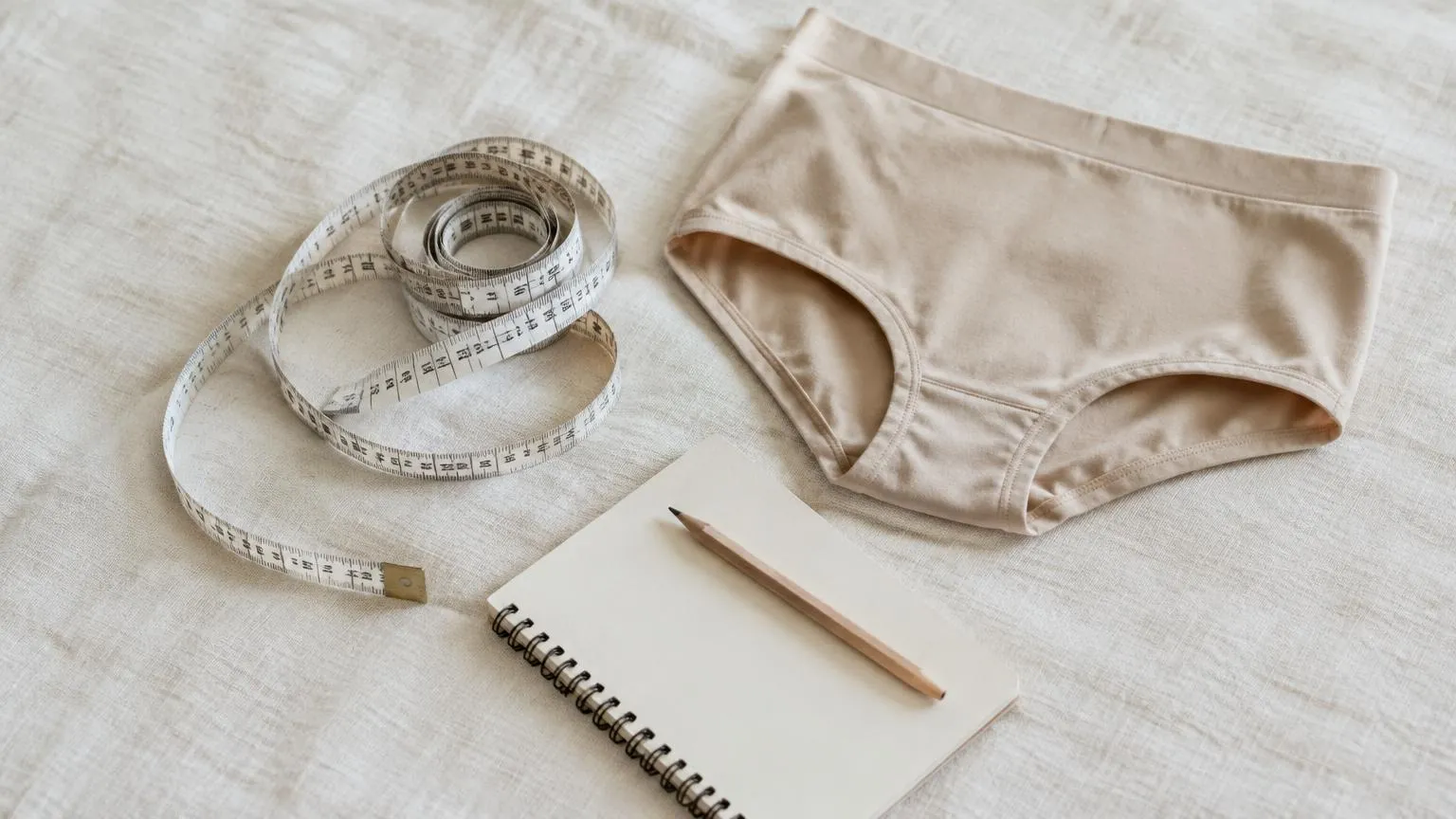
Use a flexible measuring tape and a mirror, or ask someone to help check the back. Measure against your body, not over bulky clothing. Nordstrom's body-measurement instructions say to keep the tape parallel to the floor and not measure over clothing (Nordstrom, PDF).
Find your natural waist
Bend gently to one side and find the crease, then stand upright to measure at that level. This is Nordstrom's method for finding the natural waist (Nordstrom, PDF). It isn't necessarily where your jeans sit or exactly level with your navel.
Wrap the tape all the way around. Keep it level, lying against you without pulling tight or indenting your skin. Stand comfortably, breathe normally and don't draw your stomach in. Read the tape where it meets the starting end, then repeat to check the result.
Even for low-rise underwear, use the natural waist if that's what the chart requests. Don't substitute a measurement around the lower waistband unless the brand specifically asks for it.
Find your fullest hips
Stand with your feet together. Pass the tape around the fullest part of your hips and bottom, keeping it horizontal. Check the side and back in a mirror: don't let it slope upwards over your bottom. Nordstrom specifies feet together and the fullest part of the hips and rear (Nordstrom, PDF).
Move the loop slightly up and down to find that fullest level. Keep contact without squeezing. Don't use only the width across your front or the measurement around your hip bones.
Record inches and centimetres clearly
Write down the unit beside each result. You can use either scale on a dual-unit tape, but don't mix an inch measurement with a centimetre column. The inch–cm converter helps if the chart uses the other unit.
For example, a hypothetical hip measurement of 40 in is 101.6 cm. That is a unit conversion, not a claim that either measurement belongs to a particular underwear size. Avoid rounding down just to fit a smaller row.
Work out what the labels mean
| Label on the chart | What to check |
|---|---|
| XS, S, M, L and extended letter sizes | The waist and hip ranges attached to that letter on this brand's chart |
| A bare number, such as 6 or 12 | Whether it's a brand's underwear code, a dress size or a country-specific size |
| UK dress size | That the column really says UK, then the body measurements in the same row |
| Combined sizes, such as S–M or 10–12 | The full measurement range for that combined size, not your usual single-size assumption |
A number without its sizing system is incomplete information. UK dress sizes aren't interchangeable with US or European labels. Letter sizes aren't a universal conversion between them either. Read the headings, not just the biggest number on the page.
Also check whether the figures are body measurements or measurements of the finished garment. Don't compare your hip circumference directly with the width of a pair laid flat. If the page doesn't explain what its numbers mean, ask before choosing.
A real brand-chart example
ThirdLove's underwear chart lists Medium (MD) at a waist of 28.5–29.5 in and hips of 39–40 in. Those are about 72.4–74.9 cm and 99.1–101.6 cm, converted here from its inch figures. Its Small row instead lists a waist of 26.5–27.5 in (about 67.3–69.9 cm) and hips of 37–38 in (about 94.0–96.5 cm). These are ThirdLove's chart values, not a general definition of Small or Medium (ThirdLove).
If both measurements fall within its Medium ranges, Medium is the chart's starting point. If you're between its printed ranges, don't invent a missing boundary: check the product's fit notes or ask the brand. Its page directs readers to measure the widest part of the hips, while also displaying waist measurements in the chart.
Charts belong to the brands and ranges that publish them. Don't carry that Medium label into another brand without reading its chart. Even within a brand, check whether the product links to a different chart for shaping garments or another range.
When waist and hips point to different sizes
First recheck the tape position and units. If the difference remains, you haven't measured “wrong” just because you don't fit one row neatly.
- Full briefs and boyshorts: allow enough room for the back panel and hips. Choosing only by a smaller waist measurement may leave the back or legs pulling. If the larger size is loose at the waist, compare a different cut.
- High-waist briefs: the waist needs attention because the waistband sits near the level you measured. Don't ignore a larger waist result just because your hips fit the smaller row.
- Low-rise or minimal-back cuts: natural-waist measurement alone tells you less about how a waistband will sit lower down. Hip fit, side-band construction and the gusset still need checking.
- Shapewear: follow the specific product's chart and fitting instructions. Don't size down simply to seek a firmer effect.
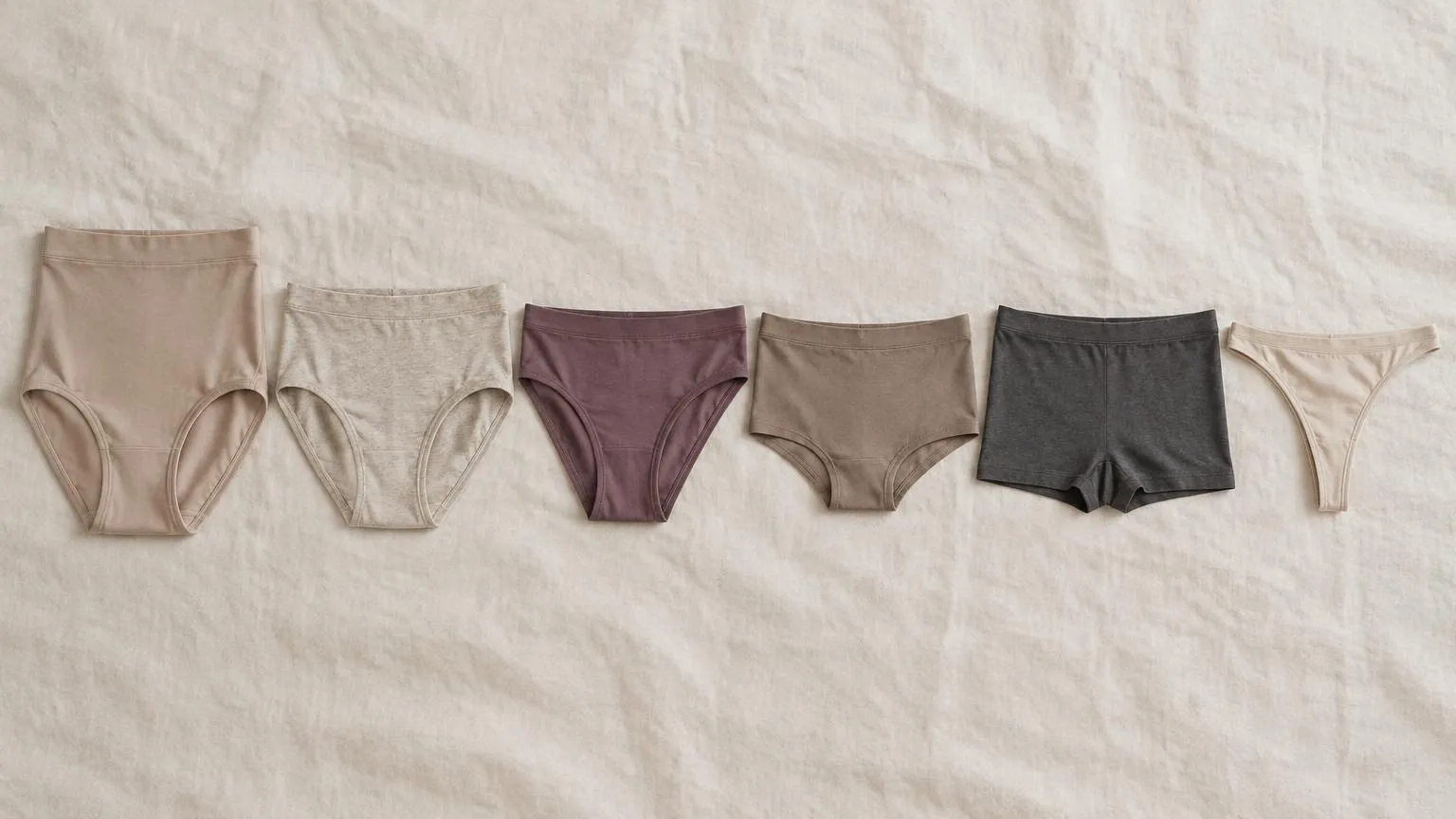
These are reasons to compare cuts, not rules that one measurement always wins. Ask the brand for guidance using both measurements and the exact product name. Our style guide shows how rise, back coverage and leg shape differ.
Don't subtract for stretch
Use your actual body measurements unless the chart explicitly asks for something else. Don't subtract a few centimetres because a description says “stretch”.
When trying it on, check the fabric body and the elastic separately. A stretchy panel doesn't tell you whether the waistband or leg opening will feel comfortable. Two garments with similar fibre percentages can still be different constructions; use the fabric guide for that part of the comparison.
Before buying, check the retailer's hygiene and returns conditions. Once you can try the pair on, sit, bend and walk. Keep the chart size only if the garment works on you, not because both measurements landed neatly in its row.
Sources and further reading
External pages referenced in this guide. Brand fitting guides describe that brand's own sizing; check each brand's chart.
- Body measurement instructions (Nordstrom, PDF) (nordstrom.com)
- Underwear Size Chart & Guide (ThirdLove) (thirdlove.com)
Report an outdated detail or broken link
Found something out of date, or a source link that no longer works? Let us know. We read every report and fix errors as described in our corrections policy.
Keep reading