How to Wash and Dry Underwear and Bras
Follow underwear care labels, decode washing and drying symbols, choose hand or machine washing, and check when briefs or bras need replacing.
By US Hosiery EditorialPublished 5 min read
The short answer
Start with each garment’s label, sort by compatible care needs, wash without unnecessary agitation and dry as directed. Assess wear by recovery, seams and fit, not a fixed replacement date.
In this guide
There's no single wash setting for every pair of briefs or every bra. A cotton-rich body can still have delicate elastic, lace or a separate lining. Start with the instructions for the finished garment, not a temperature you've seen recommended for the main fibre.
The short answer
Read the label, sort into compatible loads, measure detergent and use the permitted wash and drying methods. A mesh bag may help organise delicate machine-washable pieces, but it doesn't turn a hand-wash-only item into a machine-washable one.
For bras, Breast Cancer Now says hand washing is best; machine washing and tumble drying may affect shape and support over time. Follow the label and replace a bra when it no longer fits (Breast Cancer Now).
Read the symbols before you make a load
GINETEX explains the international ISO care-symbol system. Read the full sequence, including written instructions; don't stop at the wash tub (GINETEX care symbols).
| Symbol description | What it tells you |
|---|---|
| Wash tub with a number | Maximum washing temperature in degrees Celsius, not a target you must reach |
| One bar below the tub | A milder process with reduced mechanical action |
| Two bars below the tub | A very mild process |
| Hand in the tub | Hand washing; check any accompanying temperature instruction |
| Crossed-out wash tub | Do not wash |
| Triangle | Bleaching instructions; a crossed-out triangle means no bleach |
| Triangle with two diagonal lines | Oxygen bleach only, not chlorine bleach |
| Circle inside a square | Tumble-drying instructions; dots indicate the permitted heat severity |
| Crossed-out tumble-drying symbol | Do not tumble dry |
| Lines inside a square | Natural drying: vertical lines for line drying, horizontal for flat drying; double lines indicate drip drying |
| Diagonal line in a natural-drying square | Dry in the shade |
| Iron | Ironing instructions; dots indicate temperature severity; a cross means do not iron |
| Circle on its own | Professional textile-care instructions, not a home wash cycle |
These meanings follow GINETEX. If the label is illegible, look for the maker's instructions for that exact garment. Don't assume two similar-looking pairs can take the same treatment. If you can't establish a suitable method, ask the maker before washing.
Sort by more than colour
Set out the laundry and make separate groups:
- Colour: keep whites, pale colours and dark or strongly coloured items apart where colour transfer is a concern.
- Wash method: separate hand-wash-only garments from machine-washable ones.
- Delicacy: keep fine lace, trims and lightweight knits away from rough or heavy items.
- Compatible settings: check that every item in a load allows the chosen temperature, cycle and spin.
Fasten bra hooks before handling a load. Check for loose stitches, damaged wire channels and snagging hardware first. Set damaged pieces aside instead of hoping the wash will leave them unchanged.
For fibre differences, see underwear fabrics compared. Use those differences to understand your garments, not to overrule their labels.
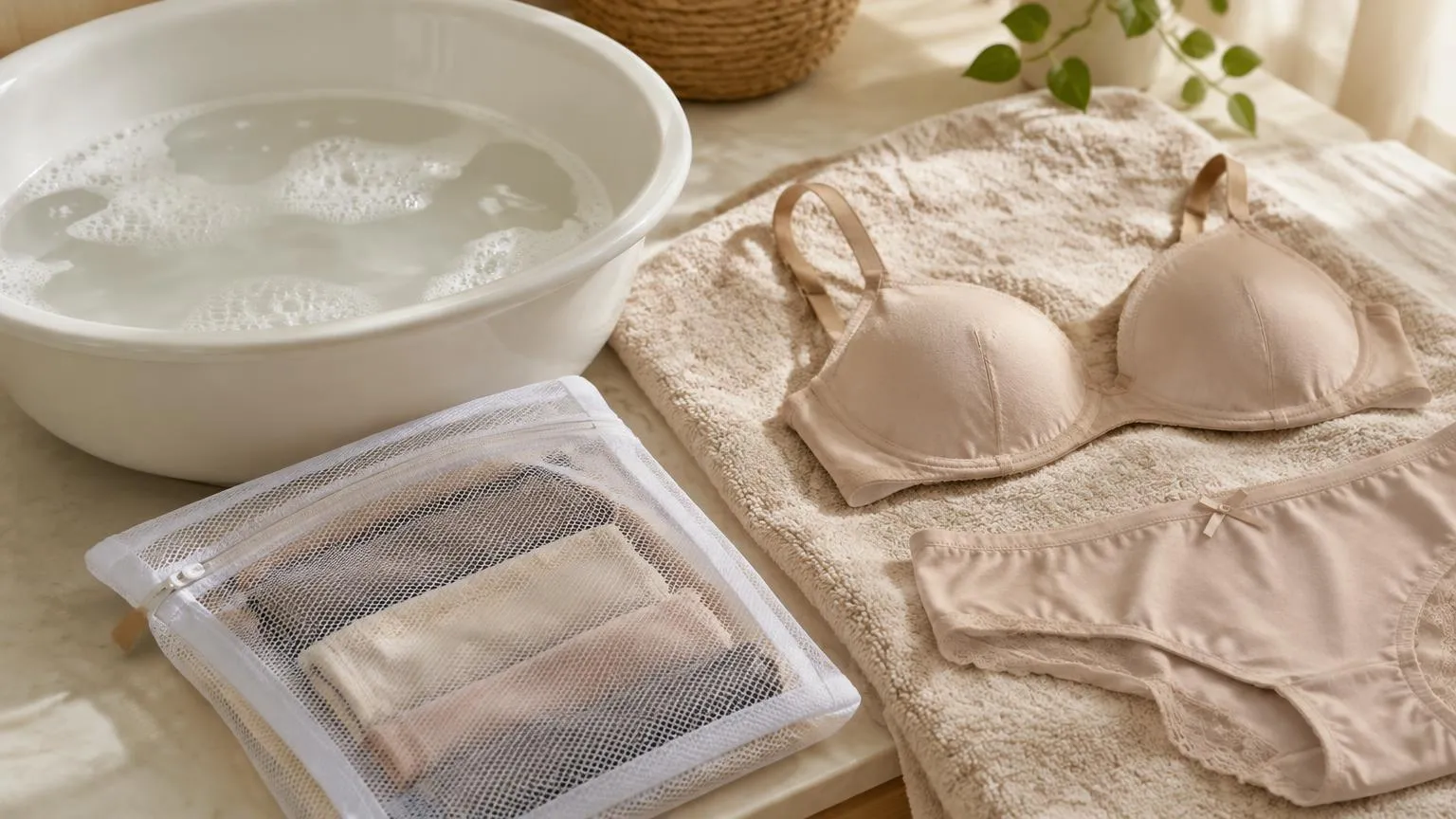
Hand washing, step by step
Where hand washing is specified or permitted:
- Use a clean basin and water within the label's limit.
- Measure a suitable detergent according to its hand-wash directions and water volume. More detergent isn't a substitute for following the instructions.
- Dissolve it before adding the garment.
- Move the fabric gently through the water. Don't scrub, pull or wring delicate pieces.
- Rinse well, press out excess water carefully and ease the garment back into shape.
GINETEX's hand-washing instructions support dissolving detergent, gentle agitation, thorough rinsing and pressing out water without wringing (GINETEX). Don't leave coloured or sensitive pieces lying wet while you finish other jobs.
Machine washing, when the label allows it
Choose the cycle and temperature the garment permits. “Delicate” on the machine isn't permission to ignore a hand-wash symbol, and two machines' programme names may differ.
You can consider a mesh laundry bag for small or delicate machine-washable items, especially pieces with hooks. It isn't protection against the wrong heat, agitation or drying method. Leave enough room for items to move rather than packing a bag tightly.
Measure detergent using the product's directions for the load, soil level and local water conditions. If you're using only a small load, don't automatically use the dose for a full one. Check bleaching instructions too: GINETEX specifies bleach-free detergent for the crossed-out triangle (GINETEX).
Don't raise the temperature just because the garment is underwear. The wash-tub number is the maximum allowed by the care symbol. If a garment needs care you can't provide, choose another piece for that use or ask the maker for advice (GINETEX).
Dry by the label, not by habit
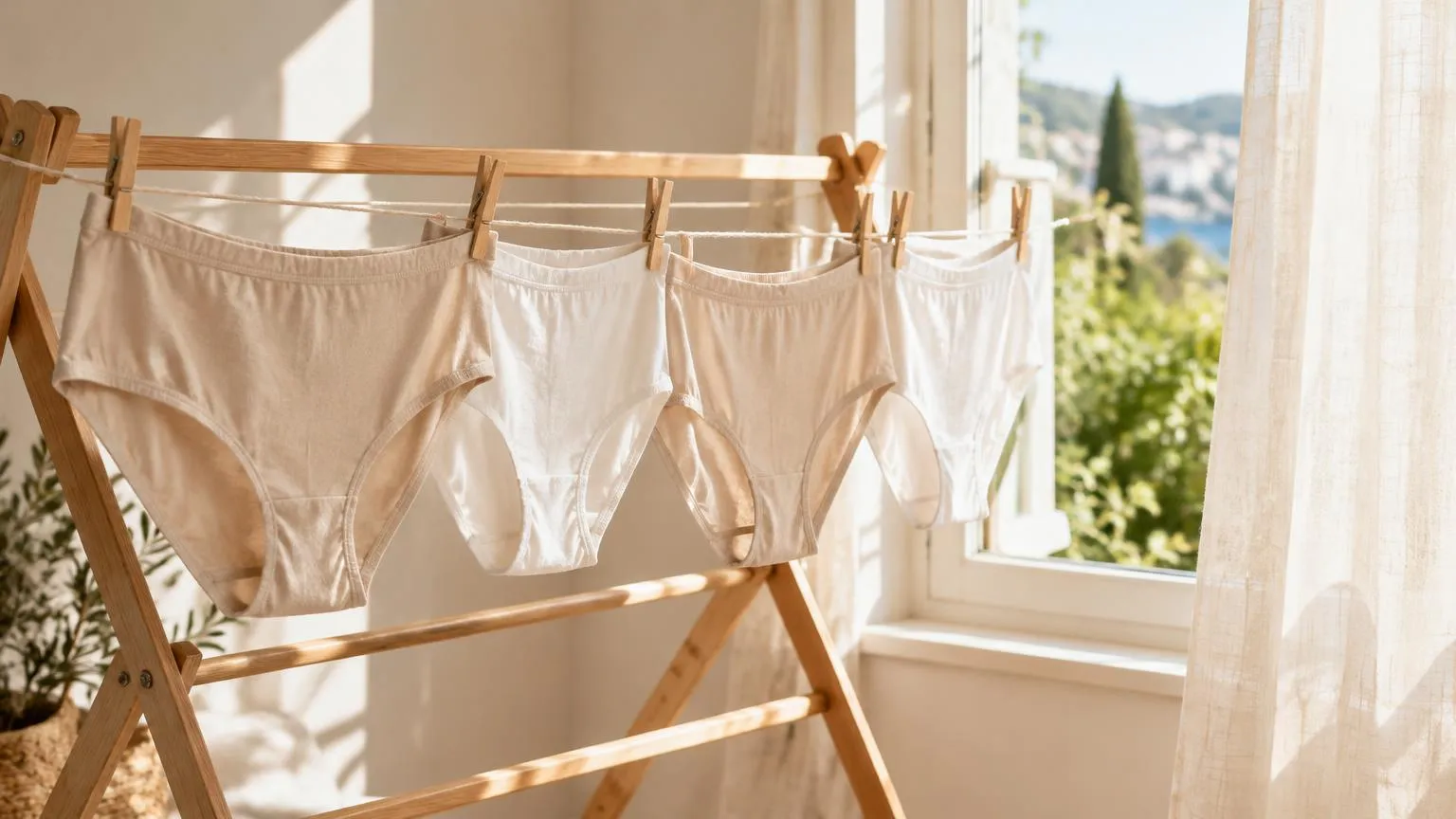
Check whether the item should line dry, dry flat, drip dry or dry in shade. These are distinct instructions. Tumble-drying permission and heat settings are separate from washing permission (GINETEX).
After washing, reshape gently without stretching openings. For flat drying, spread the item out on a suitable clean surface. For line drying, arrange it without pulling it out of shape. Leave space between pieces and check thicker bands, lining and gusset layers before putting them away.
Don't increase dryer heat to solve a slow-drying load. If tumble drying isn't allowed, choose a permitted natural-drying method. If it is allowed, stay within the stated setting. Missing drying instructions are a reason to seek clarification, not to assume the hottest cycle is safe.
If your indoor laundry often stays damp, plan more drying space and time; the hot-weather and travel guide includes packing around uncertain drying conditions.
Give bras a separate check
Breast Cancer Now recommends hand washing and warns that machine washing and tumble drying may affect a bra's shape and support over time. It also advises checking wires and strap stretch (Breast Cancer Now). A laundry bag doesn't remove that caution.
Once the bra is dry, look at its shape and put it on. Does the band stay level? Do the cups contain your breasts without gaps or bulging? Are straps comfortable without excessive tightening? These are fit checks in the same Breast Cancer Now guide. If a wire is exposed, stop wearing the bra until it has been properly repaired or replaced; don't keep pushing it back for another day's wear.
Decide when a garment is worn out
Use a condition check, not a fixed number of months:
- Stretch a waistband gently and release it. Does it recover, or remain slack?
- Look for holes, separating seams, fraying and damaged elastic.
- Notice a waistband that has started rolling or leg openings that no longer stay put.
- For bras, check wire channels, strap stretch and whether the garment still fits.
Rolling alone doesn't establish that elastic is worn out: a waistband that rolled from the first wear may be a cut or fit issue. Compare its current behaviour with how it fitted when new. If a clean, dry garment no longer stays comfortable and in place, assess repair or replacement. The underwear fit guide can help distinguish wear from a style mismatch.
Keep a photograph of hard-to-read labels and save the routine in the garment care checklist so you don't have to decode every piece again on wash day.
Sources and further reading
External pages referenced in this guide. Brand fitting guides describe that brand's own sizing; check each brand's chart.
- Care symbols — GINETEX (ginetex.net)
- Your guide to a well-fitting bra — Breast Cancer Now (breastcancernow.org)
Report an outdated detail or broken link
Found something out of date, or a source link that no longer works? Let us know. We read every report and fix errors as described in our corrections policy.
Keep reading